This is the question every visitor asks, and it is the one most guides get wrong, because they still describe Tsukiji as a fish market. It has not been one since 2018. Once you know what each place actually is, the decision answers itself — and the honest answer is usually both. Toyosu Fish Market tuna auction tours take in the pair in a single morning.
The short answer
If you want the auction, you want Toyosu, and you want to be inside by five. If you want to shop, eat and take photographs at a civilised hour, you want Tsukiji. If you want both, go to Toyosu first, because the bidding will not wait and the shops will.
What happened in 2018
The wholesale market moved. Toyosu Market opened on 11 October 2018 and the auctions, the wholesalers and the trade went with it, about three kilometres east across the bay.
What stayed at Tsukiji is the Outer Market: the retail district that grew up outside the old market walls to serve it, with fishmongers, knife shops, dried-fish counters, tamagoyaki stands and a hundred small places to eat. The history page covers the move and the two before it.
Side by side
| Toyosu Market | Tsukiji Outer Market | |
|---|---|---|
| What it is | A working wholesale market | A retail street of shops and eateries |
| The draw | The bluefin tuna auction | Shopping and eating |
| Opens | 5:00 | 6:00, and the trade has priority until 9:00 |
| Best time to arrive | 5:00 | 9:00 to 11:00 |
| Cost to enter | Free | Free |
| Can you buy? | Only in Uogashi Yokocho, upstairs | Everywhere |
| Getting there before dawn | Taxi only | Not applicable |
| Time needed | 2 to 4 hours | 1 to 2 hours |
The case for Toyosu
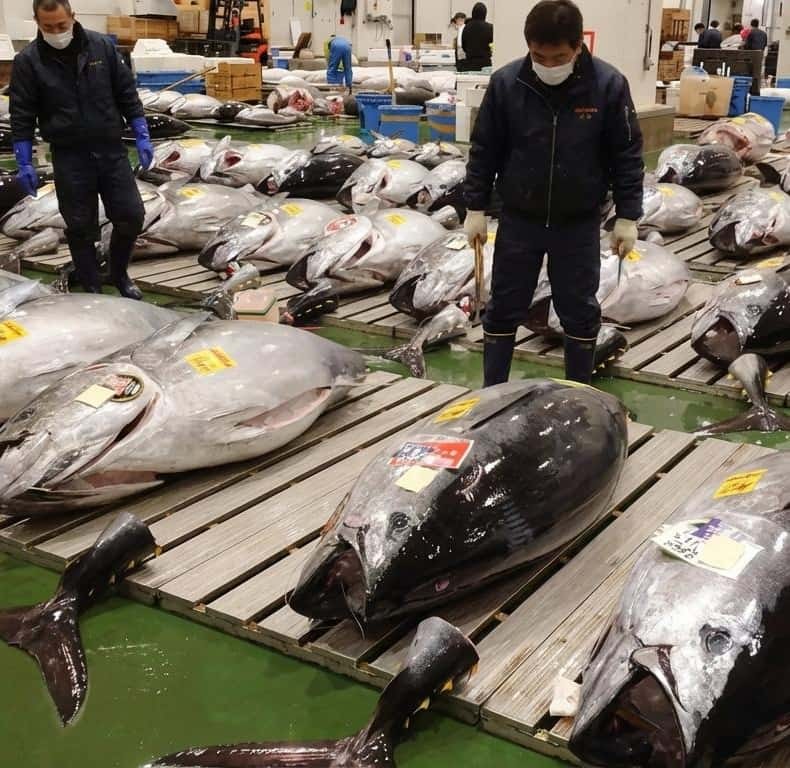
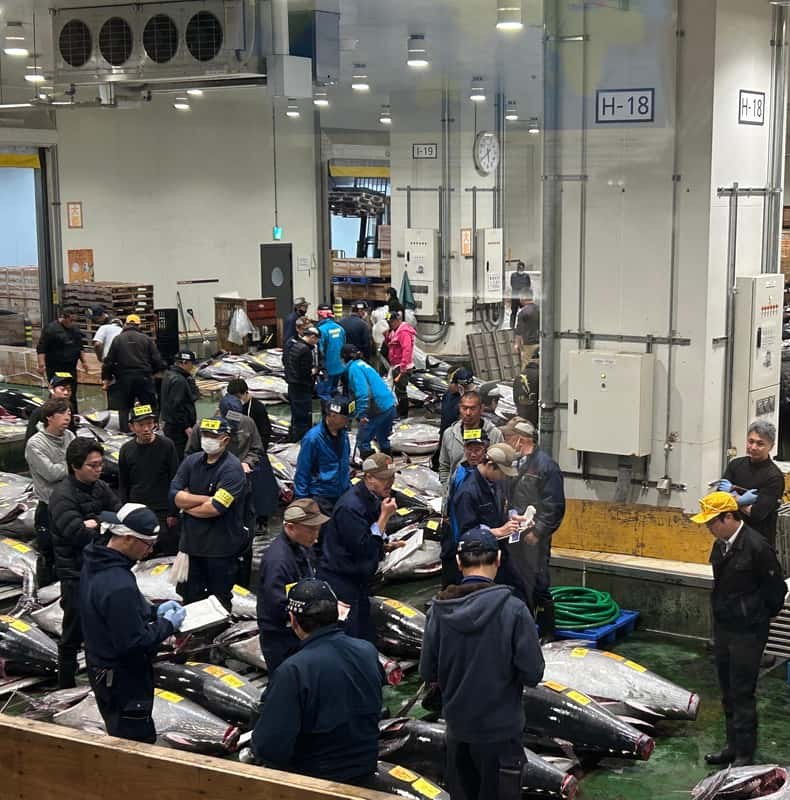
There is one tuna auction of this size on earth and it happens here, every trading morning, and it costs nothing to watch. You stand above a floor of frozen bluefin while licensed buyers walk the ranks with torches and answer the auctioneer with their hands. Nothing at Tsukiji is comparable, because the trade that made Tsukiji famous is now in this building.
The cost is the hour. Five in the morning is not negotiable, and getting there means a taxi. What happens here describes the morning in full.
The case for Tsukiji
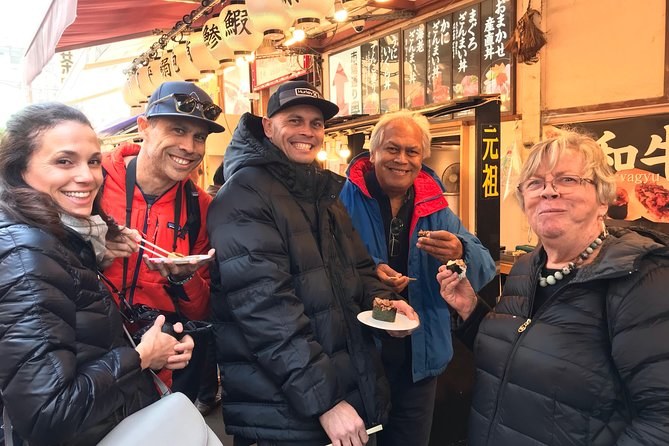
It is the more enjoyable place to spend two hours, and by a distance. Narrow lanes, four hundred shops and stalls, knives being sharpened, tamagoyaki coming off the pan, sea urchin sold by the tray, and no need to be anywhere before nine.
It is also the better place to buy anything. Nothing on the Toyosu wholesale floor is for sale to you; almost everything at Tsukiji is. The Tsukiji page covers what is worth carrying home.
Doing both in one morning
This is what nearly every guided departure does, and the order is fixed by the clock rather than by preference. Toyosu at five for the auction, breakfast inside the market, then fifteen minutes by bus or car to Tsukiji and the lanes as they wake up.
Doing it the other way round does not work. The bidding is over by half past six and the Tsukiji shops are barely open before then, so a morning that starts at Tsukiji misses the only thing that has a fixed time.
What the two have in common
More than the argument suggests. Both are free to enter, both are busiest and best early, both reward cash over cards, and both are places of work where visitors are guests rather than customers. Neither has a queue to skip, a ticket to buy or a fast track to pay for.
And they share a calendar. The Tsukiji Outer Market follows the Tokyo Central Wholesale Market's own closing days, so a Wednesday or a Sunday that shuts Toyosu will usually thin out Tsukiji as well. Check one calendar and you have checked both.
Which one if you only have one morning
- First time in Tokyo, and you can face five o'clock? Toyosu. There is nothing else like it.
- Travelling with children, or not a morning person? Tsukiji. It is the better experience at a human hour.
- Here to shop for knives or dried fish? Tsukiji, and go before nine if you want the shopkeepers' attention afterwards.
- Here for the fish itself? Toyosu, and the sushi counters inside the market rather than the queues at Tsukiji.
- Only free on a Sunday or a Wednesday? Check the calendar. Toyosu is often closed; Tsukiji largely follows the same one.
Doing both without a tour
Entirely possible, and here is the shape of it. Book a taxi through your hotel for half past four. Go in from the pedestrian deck at Block 7, watch the bidding from the corridor until about half past six, and eat at one of the counters on the third floor of Block 6 or the management building.
Then take the Toei bus from Shijo-mae towards Tsukiji, which runs once the morning service starts and takes about a quarter of an hour, or a taxi if you would rather not wait. Aim to be in the Tsukiji lanes between nine and eleven, when the trade has had its turn and the shops are open to everybody. Getting there covers the journey both ways.
What you give up doing it alone is the commentary. An auction floor is not labelled, nothing is explained, and the hand signals mean nothing until somebody translates them. Whether that is worth a fare is the honest question, and for a good many travellers the answer is no.
What each one costs
Both are free to walk into. Toyosu has no admission and no ticket at all, and the Tsukiji Outer Market is a public street. What you spend is on food, on knives and dried fish if you buy them, and on getting to Toyosu before the trains run.
Guided mornings here run from $107 to $480 a head, and the spread is almost entirely transport, meal and party size. The cheapest fare on the page is a four-hour walk through both markets that skips the auction; the most expensive collects you from your hotel by car for a party of four.
The mistake worth avoiding
Arriving at Tsukiji expecting an auction. It is the single most common disappointment at either market, and it is entirely avoidable: there has been no wholesale fish market at Tsukiji since 2018, and there is no auction there of any kind.
What there is, is a genuinely good food street with four centuries of trade behind it. Go knowing that and you will enjoy it. The best time to visit has the calendar for both.
Doing both? Toyosu Fish Market Tours shows which fares include the transfer between them, and the FAQ page answers the rest.