Toyosu is a working market that happens to let you in, which is why so much of what is interesting about it is not on any sign. Here are thirteen things that surprise people, every one of them checkable, and most of them things you can see for yourself on any trading morning. Toyosu Market tours will show you the rest.
About the market itself
1. Getting in is free, and always has been
No ticket, no timed entry, no booking. The visitor corridors, the auction viewing corridor and the rooftop garden are all free to you, as they are to anybody who walks in from the pedestrian deck at five in the morning.
2. It is only seven years old
Toyosu Market opened on 11 October 2018. The trade inside it is four centuries older: it ran at the foot of Nihonbashi bridge from about 1603 and at Tsukiji from 1935.
3. It is three buildings, not one
Three numbered blocks joined by a raised walkway, trading seafood wholesale, seafood intermediate wholesale and produce. Unless you plan the walk, you will see one of the three.
About the auction
4. The closest platform cannot be bought
The lower observation deck is allocated by ballot, run by the market itself. No operator, no fee and no queue gets you onto it, however early you are willing to stand, and the market does not publish how many places there are.
5. One application covers three dates and five people
You give up to three preferred dates and are allocated one. Five people to an application, one application per group, and photo identification for everybody on the day.
6. The hand signals predate the auction
Before the market moved to open bidding in the 1930s, fish at Nihonbashi changed hands in secret, with fingers worked inside a sleeve or a price whispered into an ear. The auction was imposed by a 1923 law and took the trade the better part of a year to absorb. The signals stayed.
7. The bidding can be over in twenty minutes
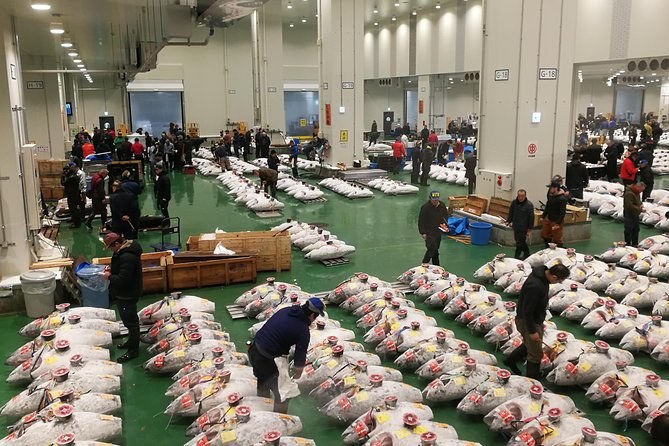
It runs roughly 5:30 to 6:30, but it has no fixed length. How long it takes depends entirely on how many fish are on the concrete that morning.
About the fish
8. Every tail has been cut open
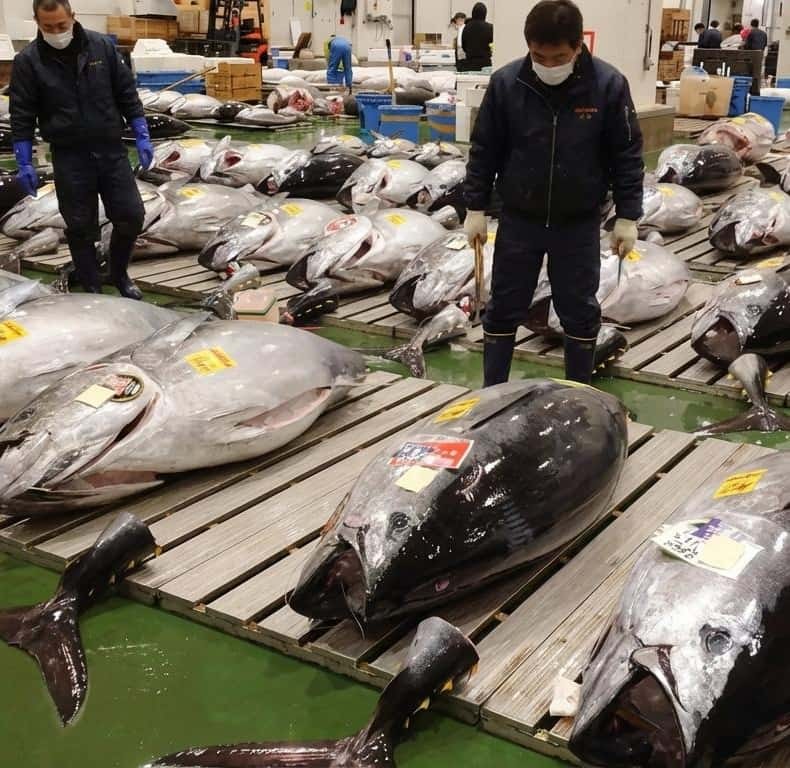
A slice is taken from each tail so a buyer can read the fat in the flesh with a torch. That cut, the shape of the body and where the fish was landed decide the price, and once somebody has shown you the cut you will see it on every fish on the floor.
9. The first sale of the year made ¥510 million
In January 2026 the top fish at the New Year auction, a 234-kilogram Pacific bluefin landed at Oma in Aomori, sold for ¥510.3 million — about ¥2.1 million a kilogram, and the highest price ever paid at that sale.
10. The buyer had done it before
The previous record, ¥333.6 million for a 278-kilogram fish in 2019, went to the same company.
What visitors walk past
11. There is a second auction
Block 5 auctions fruit and vegetables from its own floor, with its own viewing deck. It is one of the quietest places in the complex, and you will very likely have the deck to yourself.
12. There is a lawn on the roof
A rooftop garden above Block 6, open 5:00 to 23:00, market holidays included, with Rainbow Bridge and Tokyo Tower across the water. It stays open on days the market is shut.
13. You cannot buy fish on the wholesale floor
The intermediate wholesale hall sells to supermarkets, fishmongers and restaurants in quantities you could not carry, let alone eat. The about 70 shops of Uogashi Yokocho upstairs sell to anybody.
The numbers, in one place
| Opened | 11 October 2018 |
| Blocks | Three — 5, 6 and 7, joined by a pedestrian deck |
| Restaurants inside | 38 |
| Shops in Uogashi Yokocho | About 70 |
| Corridors open | 5:00 to 17:00 |
| Rooftop garden | 5:00 to 23:00, market holidays included |
| The auction | roughly 5:30 to 6:30 |
| Admission | Free |
| Ballot party size | Five people to an application |
| Ballot date choices | Three, of which you are allocated one |
| New Year 2026 top fish | 234 kg, from Oma in Aomori |
| What it sold for | ¥510.3 million, about ¥2.1 million a kilogram |
Two things that are almost always got wrong
That there is still a fish market at Tsukiji. There is not, and has not been since 2018. The wholesale trade and the auctions moved to Toyosu, and what remains at Tsukiji is the Outer Market, a retail street of shops and small restaurants. It is well worth a morning; it simply is not a fish market. The Tsukiji page sets out what is actually there.
That you need to book something. You do not. Every part of Toyosu that a visitor can reach is free and unticketed, including the corridor over the auction hall, and nobody is turned away. The only thing that is rationed is the lower deck, and that is a ballot rather than a sale.
The one number nobody publishes
How many people the balloted observation deck holds. You will find anything between twenty-seven and a hundred and twenty a day quoted elsewhere, and they cannot all be right, because the market has never published a figure. Treat every one of those numbers as a guess.
What can be said is the shape of the thing: a ballot, three date choices, five people to an application, one application per group. Visitor information sets out the process in order.
Two more that are true and rarely said
A second market runs on the same site
Toyosu handles fruit and vegetables as well as fish, in its own building with its own auction and its own viewing deck. The produce sale starts later in the morning than the tuna, which means a visitor who arrives at five can watch both before breakfast. Almost nobody does.
The market is closed more than most visitors plan for
It shuts on Sundays, public holidays and most Wednesdays, plus a handful of irregular days the market sets a year at a time, and the irregular days are set a year at a time rather than following a rule. October 2026, for instance, is closed on the 4th, 7th, 11th, 12th, 18th, 21st, 25th and 28th, which is eight closed days in a single month. The best time to visit goes through the week and the year.
Where these came from
The hours, the closing days, the free entry, the ballot rules and the market's own history all come from the Tokyo Metropolitan Central Wholesale Market and the Tokyo Convention and Visitors Bureau. The New Year auction figures were reported internationally in January 2026.
Seeing it for yourself
The auction is free and the corridor is open to everyone, so the only real obstacles are the hour and the transport. Getting there deals with the second, and a guided morning deals with both.
Want somebody to point all this out as it happens? Toyosu Fish Market Tours sets out every guided morning with what its fare covers, and what happens here puts a clock on it.