Nobody tells you this at the station, and it is the single most useful thing to know before you arrive: Toyosu is not a building. It is a complex of three, laid out across three numbered blocks with a railway station in the middle, and each one trades something different. Toyosu Fish Market guided tours start at four different points inside that square.
Three blocks, and why they are numbered
The market's own visitor map divides the site by function. Blocks 5, 6 and 7 are the addresses the trade uses, and the numbers appear on every sign, every gate and every operator's meeting-point instruction. A raised pedestrian deck runs between them, over the roads the trucks use, and every visitor route is on that level.
Visitors may enter from three points on that deck, one per block. The ground floor of the management building is not an entrance, which is the mistake that costs people the start of the auction. The map page puts all of it on the ground.
Block 7 — the Fisheries Wholesale Market Building
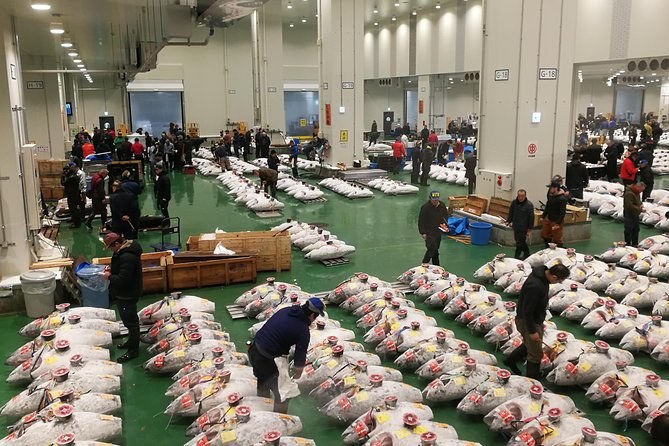
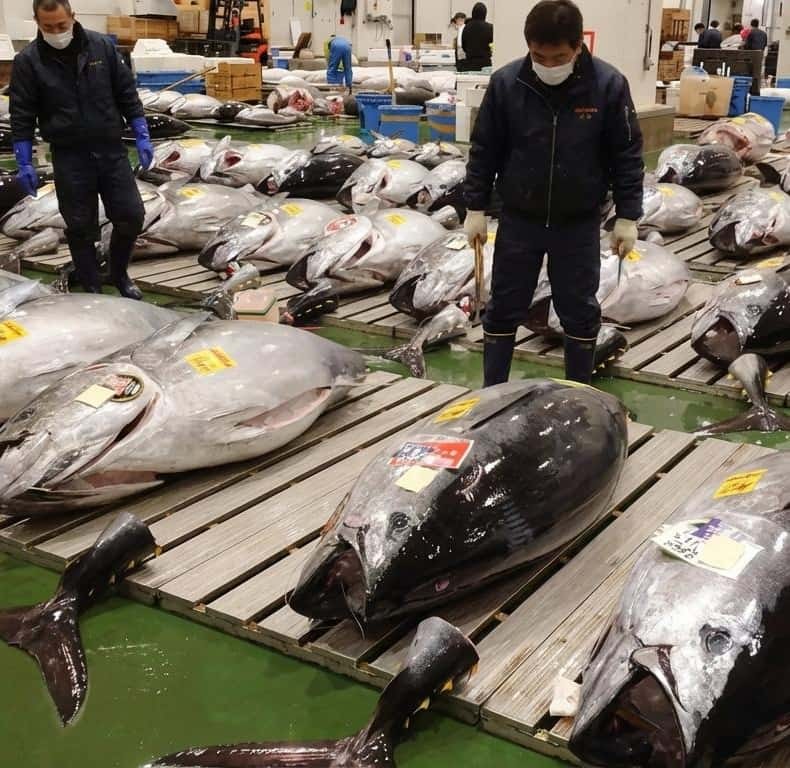
This is the one you came for. Seafood landed from all over Japan and abroad is gathered here and auctioned, and the tuna auction runs on its floor every trading morning from about half past five.
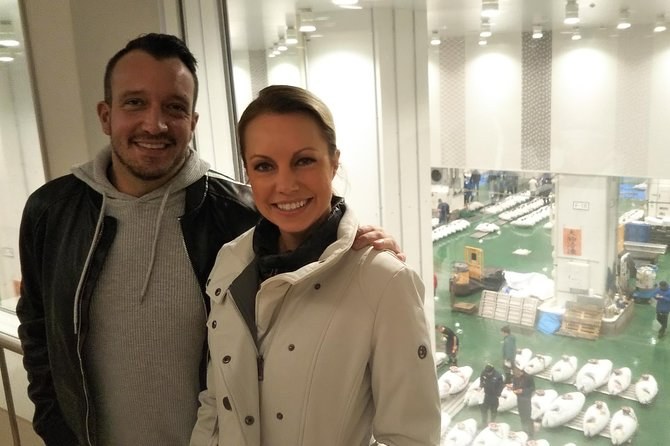
You watch from the visitor corridor above the hall, through sealed glass, with the auctioneer's call carried on speakers. Beside it is the visitor hall, which holds a life-size model of a whole bluefin — the closest most people ever get to standing next to one.
Block 7 — the Management Facilities Building
The market's offices, and two things a visitor cares about. The PR Corner on the third floor is where ballot winners gather at half past five, and it is open to everyone from half past eight to half past two on ordinary days. Thirteen restaurants sit on the same floor.
If your morning starts with a ballot place, this building is your meeting point rather than the auction hall itself.
Block 6 — the Fisheries Intermediate Wholesale Market Building
Where Tokyo's fishmongers and sushi restaurants buy the day's stock. After the auction this is the loudest part of the market: turret trucks turning in impossible gaps, band saws going through frozen loins, crates filling.
It also holds twenty-two restaurants on the third floor, a viewing gallery, and Uogashi Yokocho — about 70 shops selling knives, dried bonito, kombu, tea, pickles and the tools the trade uses. Anybody can shop there, and almost nobody does because they do not know it exists.
Block 5 — the Fruit and Vegetable Building
Toyosu is two markets and this is the second one. Produce from across Japan and overseas is auctioned here a little later in the morning, and a viewing deck looks down on the floor with three restaurants beneath it.
Almost no visitor makes the ten-minute walk. If the tuna corridor is three deep, this is where to go instead: the same open bidding, the same grading, crates of melons and mushrooms and citrus instead of fish, and room to stand.
The rooftop garden above Block 6
A lawn on the roof, open 5:00 to 23:00, market holidays included, reached by lift. The Tokyo Bay waterfront is on one side and Tokyo Tower is across the water on the other, and because it stays open on closing days it is the one part of the complex you can reach on a Sunday.
Ten minutes up there after two hours on concrete is the right way to finish, and no guided morning includes it.
Senkyaku Banrai, next door
Not part of the market, and on a completely different clock. Toyosu Senkyaku Banrai opened on 1 February 2024 beside Block 6, connected to the same pedestrian deck, with an Edo-styled eating street, a souvenir arcade and a hot-spring complex above it.
Its shops open at ten and its foot-bath garden on the eighth floor is free. A market morning that finishes at half past eight will find almost all of it shut, which is worth knowing before you build a plan around it.
How the numbering helps you at five in the morning
Every operator's meeting-point instruction names a block, a gate or a building, and almost none of them explains what that means. Knowing that Block 7 is the auction, Block 6 is the shops and the food, and Block 5 is the produce turns a set of Japanese place names into a plan you can follow in the dark. It also tells you which of the three deck entrances to walk to, which is the difference between arriving at five and arriving at ten past.
The route most mornings take
| Time | Where | What is happening |
|---|---|---|
| 5:00 | Block 7, from the deck | Corridors open; positions along the glass fill |
| 5:30 | Block 7, the corridor | The bell, and the bidding begins |
| 6:30 | Block 6, the wholesale floor | What was just sold is broken down and resold |
| 7:00 | Block 6 or 7, third floor | Breakfast, and the counters have queues |
| 7:45 | Block 6, fourth floor | Uogashi Yokocho, once the trade has thinned |
| 8:15 | Block 5, or the roof | The produce deck, or the lawn and the bay |
| 8:30 | Out to Tsukiji | Fifteen minutes by bus or car |
What you cannot do inside
Three of the blocks' rules surprise people, and all three are published by the market itself. You cannot eat or drink in the corridors, benches included, so a coffee waits for the restaurant floor. You cannot buy anything on the intermediate wholesale floor, because it sells to supermarkets and restaurants in quantities no household wants. And you cannot park: there is no visitor car park and nowhere to leave a bicycle, which is why a taxi has to drop you and drive off.
What you can do is walk in from the deck without a ticket, stand at the glass for as long as you like, shop upstairs in Uogashi Yokocho, eat at any of the restaurants and go up to the roof. Visitor information has the full list of rules and the opening hours for each area, which differ by floor.
Five things most visitors walk past
- The bluefin model in the visitor hall. Life-size, and the only way to judge the scale of what is on the floor below.
- Uogashi Yokocho. An entire shopping street one floor above the wholesale hall.
- The produce auction in Block 5. A second auction, with a viewing deck nobody uses.
- The rooftop garden. Open before six in the morning, with the best view in Koto City.
- The viewing gallery in Block 6. A second look at the trade, from above, without the crowd at the tuna glass.
Want the layout with the gates on it? The map page puts every entrance and meeting point in place, and Toyosu Fish Market Tours lists the mornings that walk you through it.