A Toyosu morning runs to a timetable set by the trade rather than by visitors, which is why the hours below are not suggestions. Here is the whole thing laid out, with what happens at each step and what you can drop if you have less time. Toyosu Market tours follow this clock with a guide attached.
What time does the morning really start?
At half past four, in a taxi. That is the honest answer, and it is earlier than any published opening time, because the transport is the part that has to be solved first. Nothing runs early enough. The first Yurikamome train reaches the market well after the auction starts, so a five o'clock arrival from anywhere but Toyosu itself means a taxi.
If you are staying in Toyosu itself you can leave at ten to five and walk. Everybody else is looking at a car. Three of the guided mornings include that ride and two collect you at your hotel door.
4:30 — the taxi
Booked through your hotel the night before, not hunted for on the morning. Ride-hailing works in Tokyo but supply at that hour is thin, and a front desk will hold a car for a stated time. From Ginza or Tsukiji the ride is ten to fifteen minutes on empty roads; from Shinjuku or Shibuya, closer to half an hour.
The roads being empty is the one advantage of the time. A journey that takes forty minutes at nine takes half that before five. Getting there has the times from eight districts.
5:00 — through a pedestrian-deck entrance
Visitors enter from three points on the raised deck, one per block, and the ground floor of the management building is not one of them. For the auction you want Block 7. The escalator shutters at Shijo-mae Station stay down until five, so before then take the stairs or the lift to the second-floor gate.
Inside, the route is signed in Japanese and English and it is short. Go straight to the glass rather than looking for the visitor hall first: the places looking down the ranks fill within twenty minutes and the hall will still be there afterwards.
5:30 — the bell, and the bidding
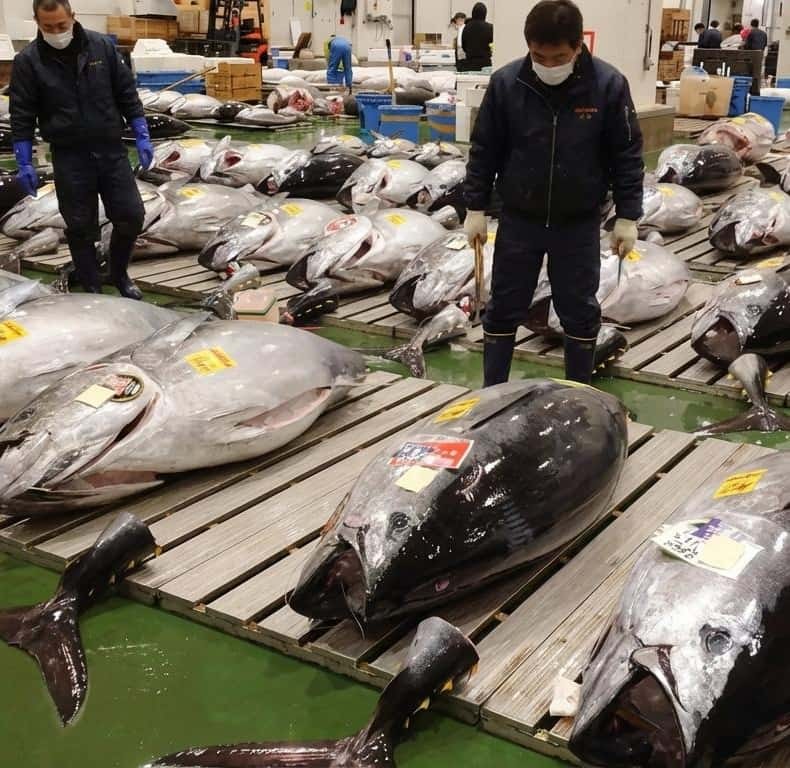
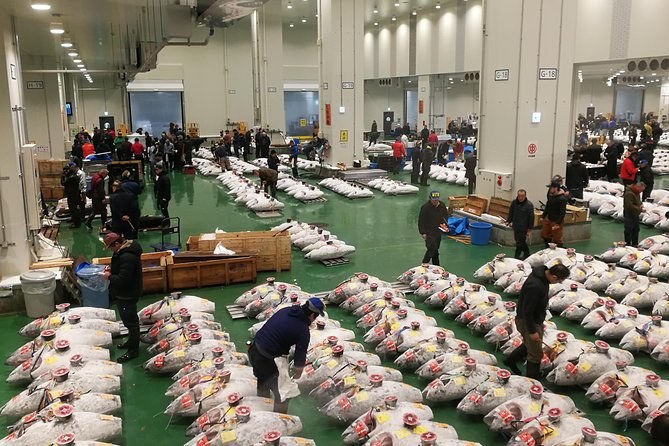
The auction runs roughly 5:30 to 6:30, with no fixed length. Some mornings the whole floor is sold in twenty minutes; some take the full hour. The auctioneer works one rank at a time and the buyers answer with hand signals, which is the part nobody explains unless somebody is explaining it to you.
If the market's ballot has put you on the lower deck, you meet at half past five at the PR Corner in Block 7 instead, with photo identification for everybody in the party. The viewing guide sets out how that works.
6:30 — the intermediate wholesale floor
This is the part most visitors leave before, and it is the best half hour of the morning. What the wholesalers have just bought is broken down and resold within the hour, so Block 6 fills with turret trucks turning in impossible gaps, band saws going through frozen loins and Tokyo's fishmongers filling crates.
You watch from a walkway. Nothing on that floor is for sale to you, because it sells in quantities no household needs.
7:00 — breakfast, and which counter
38 restaurants sit inside the market and they open with it rather than with the city, which is why a bowl of sushi at seven in the morning is possible here and almost nowhere else in Tokyo.
The best-known sushi counters have a queue by six and it does not move quickly. Several of these departures book a seat in advance, which is the difference between eating at seven and eating at eight. Bring cash. If you have a dietary requirement, the allergy guide is worth ten minutes before you book.
7:45 — Uogashi Yokocho
About 70 shops above the wholesale floor in Block 6, selling knives, whetstones, dried bonito, kombu, tea, pickles and the tools the trade uses. Anybody can shop there and almost nobody does, because most visitors do not know it is above their heads.
It is the right place to buy something to take home, and it is a great deal quieter than the equivalent shops at Tsukiji.
8:15 — the roof, or the produce deck
Two options and both are nearly empty. The rooftop garden above Block 6 is open 5:00 to 23:00, market holidays included, with the Tokyo Bay waterfront on one side and Tokyo Tower across the water on the other. Ten minutes up there after two hours on concrete is the right way to finish.
Or walk ten minutes to Block 5, where fruit and vegetables are auctioned from their own floor with a viewing deck over them. It is the quietest thing in the complex and almost no visitor makes the trip.
8:30 — across to Tsukiji
About three kilometres west, about fifteen minutes by bus or car. Several fares here include the transfer, and one names the bus fare specifically. The Tsukiji Outer Market's own shops give the trade priority until nine, so arriving a little before that means quiet lanes and about half the shutters still down.
Between nine and eleven is when it is at its best. The Tsukiji page has the hours and the eight rules the district asks visitors to follow.
The morning in one table
| Time | Where | What is happening |
|---|---|---|
| 4:30 | Your hotel | The taxi you booked last night |
| 5:00 | Block 7, from the deck | Corridors open; the glass fills |
| 5:30 | The auction corridor | The bell, and the bidding |
| 6:30 | Block 6 | The wholesale floor at its loudest |
| 7:00 | Third floor, Block 6 or 7 | Breakfast, and a queue at the good ones |
| 7:45 | Fourth floor, Block 6 | Uogashi Yokocho |
| 8:15 | The roof, or Block 5 | The lawn and the bay, or the produce deck |
| 8:30 | Out to Tsukiji | Fifteen minutes by bus or car |
| 9:00 | Tsukiji Outer Market | The lanes open properly to visitors |
What the morning feels like, as against how it reads
Written down it looks like a schedule. In practice the first two hours pass faster than anything else you will do in Tokyo, because the room is working and there is nowhere to sit. Then it changes gear completely: from about seven you are choosing things rather than watching them, and the pace is yours.
The other thing nobody warns you about is the cold. The auction hall is refrigerated in every month of the year and the floors are hosed, so an hour at the glass in a light jacket is longer than it sounds. Layers, and shoes you do not mind getting wet.
How long should you allow in total?
Four hours is the full version and it is what most guided mornings run to. Three gets you the auction, the wholesale floor and breakfast. Two gets you the auction and a walk, which is a real visit and is what a great many people do.
Anything under two hours means leaving before the interesting part, because the bidding is only the first act.
What can you cut if you only have two hours?
Cut from the back, never from the front. The auction has a fixed time and everything else does not.
- Keep: the corridor from five, the bidding, and twenty minutes on the wholesale floor afterwards.
- Cut first: Tsukiji. It deserves its own morning at a better hour.
- Cut second: Uogashi Yokocho, unless you came to buy a knife.
- Cut third: the produce deck in Block 5.
- Never cut: breakfast. It is the thing people remember.
Frequently asked questions
How early do I have to get up?
Can I do this and still have a full day?
Is breakfast worth the queue?
What if the market is closed that day?
Do I need to bring anything?
Can I do the morning in reverse, Tsukiji first?
Want this morning with the taxi and the guiding handled? Toyosu Fish Market Tours lists every departure with its start time, and the map page shows which entrance each one uses.